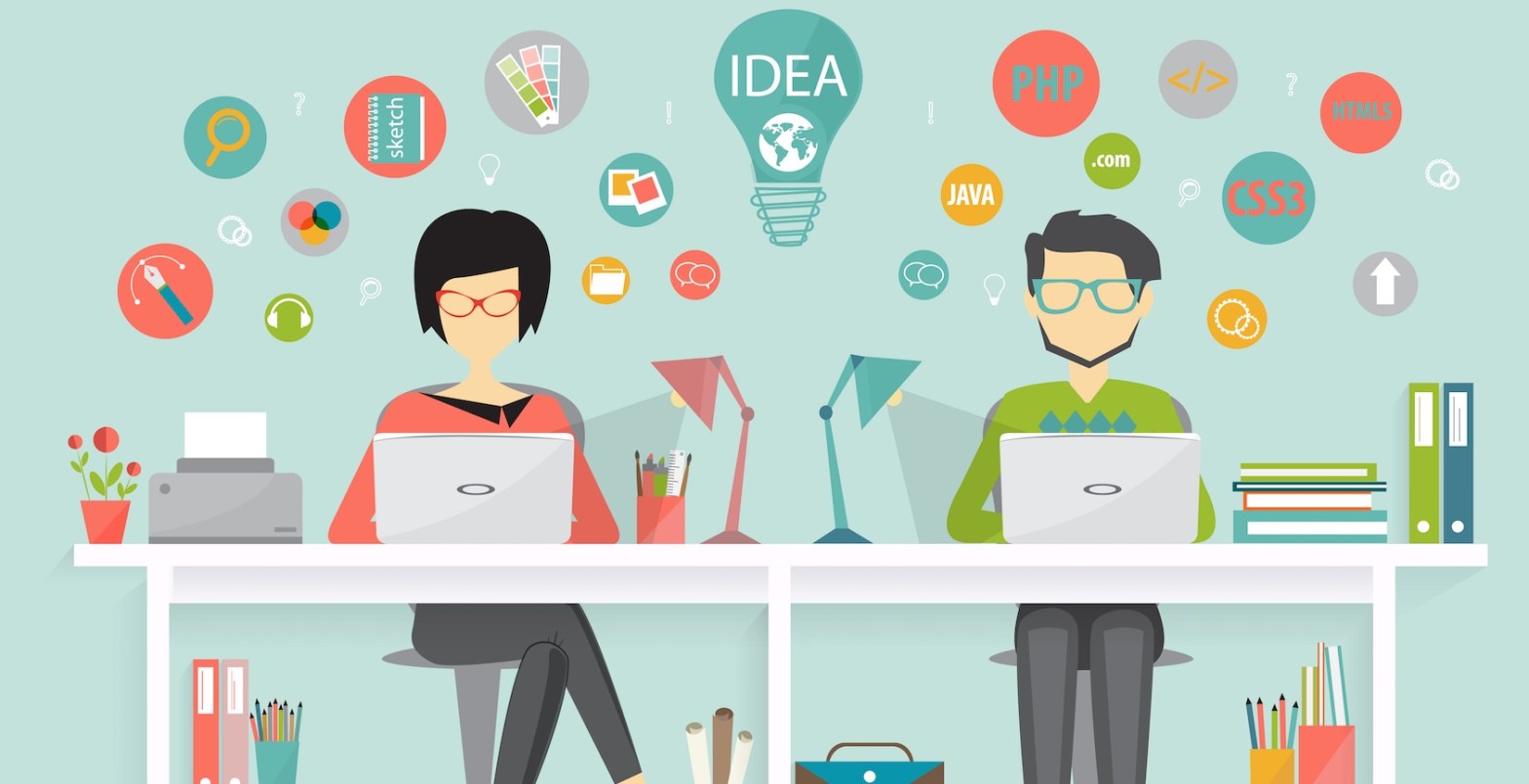
I suggest you highlight two professions little or little known on the web: graphic designer and web designer. Often associated with purely technical or computer skills, these two professions require artistic and empathetic know-how to satisfy the same cause: the user experience. Here is my definition of these two professions and a focus on the one I have been practicing and adoring for almost ten years: UI / UX web designer!
WHAT IS A GRAPHIC DESIGNER OR GRAPHIC DESIGNER?
A graphic designer combines texts and images to create designs and communication media. He generally has a fairly versatile profile with several areas of expertise: publishing (print), the web, etc. He knows how to create a whole graphic universe for a company and a product while giving a visual identity, brand identity (branding).
Its goal is to captivate the target audience and deliver a certain message. The message can be intended for an online or offline audience. In short, a graphic designer deals with the appearance of objects. This is to make “static designs” as attractive as possible.
WHAT IS A WEB DESIGNER OR WEB DESIGNER?
The profession of web designer/web designer can be divided into a specialty:
- UI web designer (User Interface),
- UX web designer (User eXperience).
User interface designers are either responsible for the layout of an application or website or how the service or product will be presented to visitors. Simultaneously, user experience web designers are more concerned with what happens when you interact with the website interface. Together, they work on how its user perceives the product or service.
Their objective is to maximize the simplicity and the pleasure of use. A few years ago, I was persuaded that it was so nice that I changed my career two years ago, going from asset manager to UX & UI web designer (with a strong preference for ” WordPress web design “)! I could never choose between one or the other, so I specialized in both.
TWO DIFFERENT BUT COMPLIMENTARY WEB PROFESSIONS
As you would have known, a comic book artist’s career is distinct from that of a web designer regarding the job’s process and goal. Note that web designers are currently in high demand around the world. Leveraging both design thinking and software engineering, we bridge the gap between how things look and how they work and are at the forefront of product design in the emerging technology industry.
On the other hand, the job market has stagnated for the profession of a graphic designer. This creates stiff competition where only the most skilled graphic designers join the best positions.
As a result, many graphic designers are turning into web designers… And you, if you were concerned, would you be ready to make the switch?
MY 5 TIPS FOR BECOMING A WEB DESIGNER
1. PUT YOURSELF IN THE INTERNET USER’S SHOES
An excellent web designer is one who does not have all the answers… Uh, what? The key is to understand that all of your customers are different and that one solution won’t work for everyone. You have to figure out exactly what they need and then create it for them. Often, giving them an answer will not be enough. You will need to make sure you have done your homework and have given your customers your reasoning as to why your response is the most important.
Prepare to question your beliefs, preconceptions, etc., every day. and to have to work hard for each change you make because you must take into account the needs of end customers (Internet users) in each web implementation.
2. WEB DESIGN IS A SCIENCE AS MUCH AS AN ART
As a web designer, you too must be a user of the product or service you are working on. Discover it and appreciate it! In practice, this can sometimes be more complicated. For example, a company wants to give you a mission, but you do not approve of its activities (out of personal convictions, ethics, etc.). I recommend that you reject this task because this is a very sensitive matter. Indeed, no one can design an intuitive and efficient user interface of a product or service that we do not subscribe to or of which we have no idea.
To prevent this from happening, I, for my part, clearly indicated on my home page my page that I was choosing my web clients! It may seem like a luxury to you, but it is a real comfort daily in reality. I am very attached to my clients, and it is always a pleasure to talk to them. We, therefore, maintain healthy and constructive relationships.
THE WEB DESIGNER LEADS A “SCIENTIFIC INVESTIGATION”
Research and user testing is a big part of web design. Your intuition and any form of personal influence or belief should never get in the way of the conception process. All that matters is user perception. This means that you will need to conduct interviews, studies, surveys, and tests to validate your design and fully meet user expectations.
THE WEB DESIGNER HAS AN ARTISTIC SENSIBILITY
Finally, as a web designer, you must understand that the definition of “beauty” is different from Larousse. Indeed, when we speak of a “beautiful website”, we do not judge only the aesthetics but also the emotions it transmits. We are interested in the website’s pleasure by browsing the different interfaces, pages, articles, etc. The desire to buy for e-commerce. So it’s not just limited to the eyes. You have to trigger a heart stroke, like a real estate purchase! It requires you to have a real emotional quotient and a lot of empathy
To become a web designer, you must not only master the technique and adopt a scientific approach in your research, but you must also be an artist!
3. THE INTERNET USER MUST HAVE QUICK AND EASY ACCESS TO INFORMATION
One of the key reasons for the web designer’s success is accessibility to information on the subject. A web page should provide a user no obstacle in its pursuit of a goal. Internet users browse the internet primarily to seek answers and not simply to “admire” websites. Going from graphic designer to web designer means keeping this fundamental notion in mind and ensuring that every web design is as simple as possible. It is very important to make it as easy as possible for users to find your content. The entire interface of the website should be reasonable in its layout and open to every end-user.
A well-known rule recommends that you find the information you are looking for in a maximum of 3 clicks. I will add to that a very explicit quote: “A customer does not buy what he does not understand”.
4. FOLLOW WEB DESIGN TRENDS AND STANDARDS
Like programming, UI / UX design includes technical norms and standards of use. This is the case, for example, for the design of an Android interface for the Google Play Store or iOS (Apple Store). It is therefore essential to follow them to avoid confusion in the minds of users.
If you completely detach from already established patterns and usage patterns, you risk losing your potential leads. Many of them won’t even bother trying to figure out how your interface works. They will head to another website or application that matches what they already know.
However, this does not mean that it is forbidden to be original! Just assume that you are personalizing your work to some extent. Unless you work at Apple or Google, it is not recommended that you reinvent complete design patterns that your users are already used to. That is the job of these large groups and communication geniuses! When it comes to UX, it’s not creativity but the ease of use that comes first.
Finally, know that the notion of UX applies subsequently in other disciplines of very (too) technical origins such as natural referencing. We are talking more and more about SXO for Search Experience Optimization.
5. BROWSE THE WEB
A basic but often overlooked piece of advice is to visit as many websites as possible to obtain a deeper understanding of the internet. It’s an inexhaustible source of inspiration and, in my opinion, the best way to approach the same subject from different angles and different approaches. This is also one of the tips that I remind most of my contacts at Lyon’s web agency.
As you explore the web, write down what you like … and what you don’t like:
- What differentiates a website from its competitors.
- It makes it easier for you to search around for the content you want to access.
- The menu.
- The number of clicks or actions to reach the information sought.
- The use or not of videos.
- Etc.
All of this will help you tremendously when designing your websites. You will then learn from what others have done and avoid as many misjudgments as possible.
TO CONCLUDE, MORE OF A GRAPHIC DESIGNER OR A WEB DESIGNER?
If you plan to become a web design professional, bear in mind that there will be major changes in your work and the attitude you must have to do your jobs. The hardest part of this transition might be changing your perception of design, purpose, and what surrounds you. Also, you will reduce your scope of multi-support to specialize in web support exclusively.
And the opposite? Go from web designer to graphic designer? Excellent question, which unfortunately I do not have the answer to. I don’t think I can do it for lack of trade-specific technical knowledge/skills, particularly in terms of the expert use of software related to the profession. And from a personal point of view, I would have a hard time not working on UX or UI anymore, so fascinating I find behavioral and psychological notions.
Are you ready for the launch of your online solopreneurs positions? Do you need to find a Web Development in Pakistan to make your site better? We plan to include several different forms of Web Design and Development services. We can build custom applications, implement a new web design, and tune your web content for search engine effectiveness.
 The Bloggify